|
Westport’s Aerostar calls out
NSTAR.
Letter to the Editor
Monday, June 21, 2010
“In the June 8 edition of The Herald
News, NSTAR commented on the small wind turbines at Noquochoke Orchards in
Westport. Because of onerous and expensive requirements by NSTAR, the three
turbines remain still. In his letter to the editor, NSTAR spokesman Michael
Durand said NSTAR is proud of its reputation as a champion of renewable
energy. A champion is someone who fights for, defends or supports a cause.
Let us take a look at how NSTAR has championed the interconnection of the
turbines at Noquochoke.
|
Related
story.
No spin zone
at Noquochoke Orchards. Read more with photos.
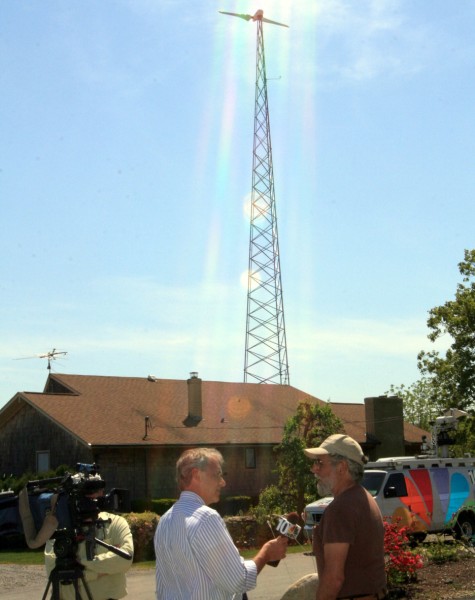
“They’re not turning,” orchard operator George Smith told WJAR
Channel 10 reporter R.J. Heim. “It’s been three months and it’s always the
same answer from NStar; we’ll get a decision to you in two weeks!”
|
Last July, we sent letters to NSTAR
expressing concern over the burdensome and costly policies NSTAR was imposing
on people wishing to interconnect small induction wind turbines. We asked for
clarification of NSTAR’s position so we would be able to inform our clients
regarding NSTAR policies and the cost of interconnection. One of our
questions related to NSTAR’s demand for a “utility grade relay.” We did not
understand how NSTAR could require the use of a utility grade relay when the
term was not found in the Massachusetts regulations governing
interconnection. We also asked about the application fee, which is based on a
minimum turbine size of 100 KW, 10 times the size of the Noquochoke turbines.
 We asked about other fees, such as engineering fees,
supplemental review fees, witness test fees and travel time fees, all of
which add up to thousands of dollars. NSTAR also demands submission of plans
signed by a Massachusetts licensed electrical engineer, likely to add
thousands more to the interconnection cost. We asked about other fees, such as engineering fees,
supplemental review fees, witness test fees and travel time fees, all of
which add up to thousands of dollars. NSTAR also demands submission of plans
signed by a Massachusetts licensed electrical engineer, likely to add
thousands more to the interconnection cost.
Until a few weeks ago, the only response was a cryptic e-mail primarily
concerned with the interconnection requirements in New York state, which have
no effect in Massachusetts, so NSTAR’s response was meaningless. How does
NSTAR’s ignoring customer requests for clarification champion renewables?
“Small induction wind turbines are
inherently safe, even without expensive relays. In the real world, the
chances of one of these turbines back-feeding the grid approaches infinity.
NSTAR was asked if it could provide one instance in which a small induction
turbine caused injury or damage. They have not provided a single example.” – Paul L. Gay
NSTAR did not respond until a couple
of weeks ago, nearly a year after our initial requests, and only after
political and media pressure. Most of our questions were ignored and remain
unanswered. The response was largely the result of Rep. Michael Rodrigues’ tireless
efforts to help the orchard. Others have also helped. In spite of these
efforts, the turbines are still not connected.
NSTAR’s letter states safety of its customers and the reliability of the
electric system are of paramount importance. We agree — that’s why our system
has a UL listed safety relay. NSTAR has stated our protective relay is not UL
listed even though they had documents in their possession that clearly show
it is. Our relay has been accepted by many utility companies in the U.S. Its
quality and safety have never been questioned, except by NSTAR. In other
states, our turbines were interconnected without delays and without expensive
fees. These utility companies really do champion renewables. Aerostar, a
Massachusetts-based small wind turbine manufacturer, finds support for its
technology in other states, but not in its own.
It was pointed out to NSTAR that one of our early turbine designs was
interconnected to the NSTAR system from about 1980 through 2008 without a
single safety incident. Because safety relays were not required at the time,
this turbine had no safety relays. If the turbine really did represent a
hazard to public safety, why didn’t NSTAR take steps to install their special
“utility grade” relays? Doesn’t NSTAR have a safety obligation to the public,
or does it only require this of others?
Small induction wind turbines are inherently safe, even without expensive
relays. In the real world, the chances of one of these turbines back-feeding
the grid approaches infinity. NSTAR was asked if it could provide one
instance in which a small induction turbine caused injury or damage. They
have not provided a single example.
NSTAR claims it must follow “statewide safety standards” and that it cannot
apply the standards to some installations and not others. NSTAR’s flawed
logic is that it insists on applying the same standards to a tiny 10-KW home
generator as a multi-megawatt, utility-scale generator. For a megawatt-sized
turbine, spending $5,000 or $10,000 on interconnection fees and equipment
might amount to 0.03 percent of the total cost. For a 10 KW generator,
interconnection fees being imposed by NSTAR could amount to one-third the
cost of the turbine. It makes small induction wind turbines uneconomical in
Massachusetts. The result is that homeowners in Massachusetts who want to
support renewables and local companies that sell and install small wind
systems are being deprived of choice.
Thanks to the foresight of our state government, Massachusetts has excellent
financial incentives for small wind turbines. However, the huge
interconnection costs being imposed by NSTAR largely negate these benefits.
Because the incentives paid to small wind turbine owners come from public
trust funds, wasting this enormous amount of money on unnecessary
interconnection costs and enriching NSTAR shareholders with application and
other fees is a misappropriation of public funds.
The interconnection rules in our state give NSTAR the freedom to approve
alternative equipment and methods. NSTAR has chosen to ignore this provision
and apply the same standards to a homeowner’s wind turbine as it does to a
utility scale turbine. In fact, Durand implies the farmers at Noquochoke
Orchard are “developers,” as if they were installing their turbines as a
profit-making venture instead of using the turbines to offset their
electrical usage. Before NSTAR is able to actually champion renewables, it
will need to learn to provide support, not place obstacles in the way of
folks who invest their life savings in renewables because they are trying to
create a better environment for their children and the children of others.
At a recent meeting with NSTAR, we suggested they allow our UL listed
protective relay be used at the orchard. We suggested they monitor the system
and use it as an educational tool. We offered to allow them to install their
own protective relay if they so desired. We suggested this would ease the
financial burden on our clients, and NSTAR would have the opportunity to
actually participate and work on a green project. Everyone involved would
benefit. Although this was an opportunity for NSTAR to actually champion
renewables, not just talk about it, our offer was declined.
NSTAR reported profits in 2009 of more than $250 million. Some of this money
likely came from fees imposed as a result of the interconnection of
renewables. If we think of money as green, then there would seem to be little
doubt that NSTAR is indeed a green company. In the case of NSTAR’s being a
champion of renewables, they have shown their true colors, and it is not any
shade of green.”
Paul L. Gay
Aerostar, Inc.
Westport
Is art alive and well in Westport?
EverythingWestport.com
Friday, June 25, 2010
View hi-resolution photo album. 21 photos | Broadband/DSL speed |
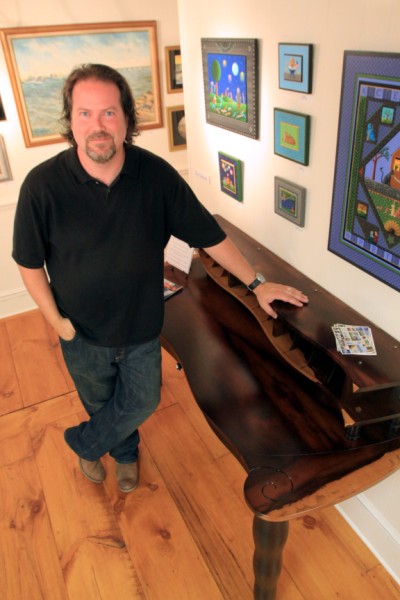 Yes, and its selling briskly at the Central Village Art Gallery, located at Village Commons, 770 Main Road, Westport. Some
of the area’s most talented artisans are displaying quality paintings,
sculptures, pottery and furniture that sure to turn your head. Just visit the
new Central Village Art
Gallery for
quality art at reasonable prices. Yes, and its selling briskly at the Central Village Art Gallery, located at Village Commons, 770 Main Road, Westport. Some
of the area’s most talented artisans are displaying quality paintings,
sculptures, pottery and furniture that sure to turn your head. Just visit the
new Central Village Art
Gallery for
quality art at reasonable prices.
Left: Thom Scott,
furniture maker.
Now open, the exhibition will
run through September 12, Labor
Day. Featuring area artisans, the gallery builds on the success of
last December’s holiday season, and will display artists Jane O'Hara, Nancy
Shand, Phyllis Dobbyn Adams, Kris Donovan, Trish Hurley, Debra Lee Valeri,
Patricia Walsh, Don Cadoret, Sue Waring Prideaux,  Janice Sexton, Denise Zompa, Barbara
Chadwick, Wayne Fuerst, and Christine Bean. Also featured will be
photographer Karen Raus and furniture maker Thom Scott. Located next to Sticks, Stones &
Stars. http://www.centralvillageartgallery.blogspot.com/ Janice Sexton, Denise Zompa, Barbara
Chadwick, Wayne Fuerst, and Christine Bean. Also featured will be
photographer Karen Raus and furniture maker Thom Scott. Located next to Sticks, Stones &
Stars. http://www.centralvillageartgallery.blogspot.com/
The opening reception was Friday June 25th from 5:00 – 8:00 p.m. Come
on down and say hi, and see why Westport is home to the finest artisans on
New England’s southcoast!
 
Left: Janice Sexton Right: Debra Lee
Valeri
 

Above: Wayne Fuerst, master potter, of Sticks, Stones & Stars
Westport’s Mary Burns has a
recital.
EverythingWestport.com
Monday, June 21, 2010
Westport’s much loved piano and
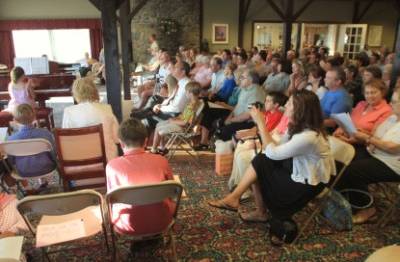
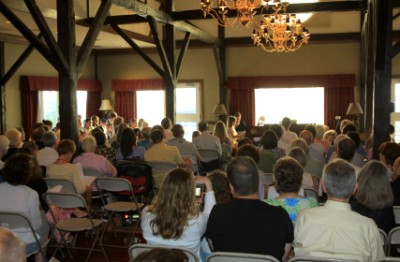
singing instructor, Mary Burns, held her annual piano recital Saturday, June 21
in the spacious lobby of the Sakonnet Bay Retirement Living in Tiverton to a
capacity crowd of parents and guests. From Johann Sebastian Bach to the Beatles, they covered it all.
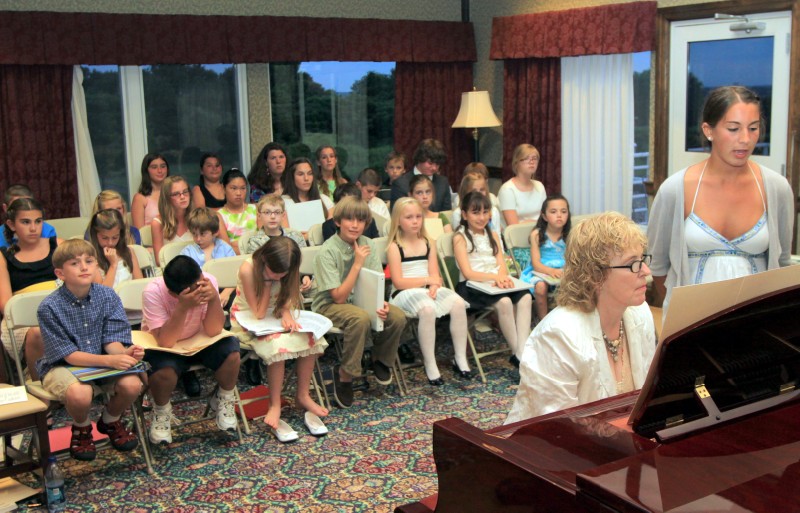
35 of Ms. Burns’ students, mostly
from Westport and Little Compton, played selected pieces, some quite
complicated, and all very well performed. “I cherish these events,” Ms. Burns
said. “It inspires my students and gives them a chance to play and receive
compliments for their efforts.”
“I never had a student I didn’t like,”
Ms. Burns said. “I have had several children who started with me at seven
years old, and stay on until they go to college. That’s when I really miss
their smiling faces.”
Ms. Burns has been holding these
recitals since 1985, and has watched her students mature physically and
musically over the years under her tutelage. “I remember them all,” Ms. Burns said. “They
are all special to me.”
.
For more information or to reach Mary
Burns, please call (508) 636-5777.
- - - - - End -
- - - -
© 2010 Community Events
of Westport All rights reserved.
EverythingWestport.com
|