Westport in Brief!
EverythingWestport.com
Sunday,
October 10, 2010
photos/EverythingWestport.com
Quick Article Index . . .
Somerset - Inside the cooling towers at Brayton Point.
|
Somerset -
Inside the cooling towers at Brayton Point. EverythingWestport.com Sunday,
October 10, 2010 photos/EverythingWestport.com View
the photo album for this event now 40 photos | Dial-up
speed |
Broadband/DSL
speed |
Westporters have been driving by the rising twin
towers on their Interstate 195 sojourns to all points west for the last few
years, and neighboring residents have been grousing about them since day one.
So what is going on at the Brayton Point Power
Plant? First operational in 1962, the 1600 megawatt Brayton
Point Station is the largest fossil-fuel power plant in New England, on 250
acres, and responsible for 6% of the region's power. Environmentalists had long pointed fingers at the plant as a key
reason why marine life in the bay has dwindled significantly at least since
1984. However, Brayton Point officials had fought
back saying say they had worked hard to minimize the plant's impact, to the
point where other factors, such as overfishing, now may play a larger role in
marine life declines. But the EPA resolved the issue on August of 2002 by releasing a draft
permit that had two primary goals to keep the plant open: it required Brayton Point to reduce its annual heat discharge to the
bay by 96%, and its intake of water by 94%. The requirements were so strict
that engineers from the EPA's regional office couldn’t think a precedent for
them. The EPA didn’t specify how these reductions could be made, but the
consensus was that the only way for Brayton Point
to meet these limits was to erect a sprawling field of towers to reduce the
seawater’s temperature in the plant's cooling system to ambient air
temperatures. "Technically, we didn't tell them what to put in," said Phil
Colarusso, an EPA marine biologist was reported to
have said. "Realistically, that's what they'll need." Open House at Brayton Point Starting at 9:00 a.m. Sunday morning,
busloads of over 1300 visitors rubber-necked the facility, stopping to gawk
at the 497 foot-tall, eggshell-thin twin towers that are made up of thousands
of truckloads of concrete and enough rebar (reinforcing rod) that if lined up
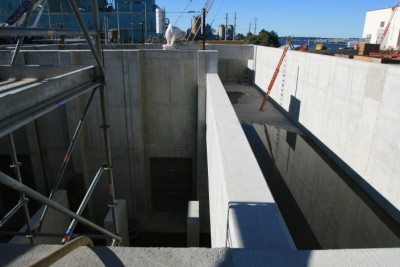
end to end would stretch from here to Houston and back. The tour consisted of a visit to
cooling tower S1, the partially completed pump house, and the upper discharge
basin. The cooling towers - the first to be
built in the country in more than 20 years - measure 406 feet in diameter at
the base and 233 feet at the top. The poured concrete walls, though, are
surprisingly thin; 20 inches at the base, 9 inches in the upper section, and
15 inches at the top rim. “The project will reduce our
annual heat discharge to the bay by more than
95 percent,” according to Kenneth Holt, Nuclear Communications Manager for
Dominion in Waterford Connecticut. The monolithic structures, larger
than most of the world’s eight wonders in biblical times, are eerily similar
to cooling towers used by nuclear facilities. Like nuclear facilities they
are part of a ‘closed-loop system’ that is Dominion Energy’s response to the
EPA’s stringent requirements to keep the plant operating. “Massive amounts of water are
required to drive the steam-operated turbines that produce the 1600
megawatts,” Holt said. “And equally large amounts are needed to cool the
superheated steam back into liquid form to be reused in driving the
turbines.” The EPA limited the facility to 70
million gallons of water discharged into the Taunton River per day. And the
plant’s annual heat discharge into the bay had to be reduced by 96%.
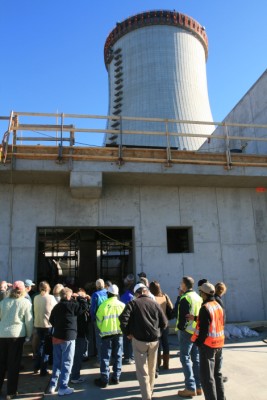
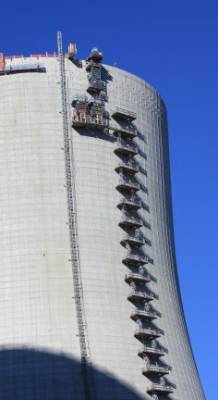
Left: The eggshell-thin cooling towers are
near completion with tower #2 receiving its last five-foot concrete pour. Center:
Visitors take a tour of the new pump house that will deliver hot water to the
towers and push it back into the closed loop for reuse in the heat exchange condenser. Right:
It takes 30 minutes for a person to climb the emergency staircase to the top
of the 497 foot tall tower. Workers normally ride the transport rail system
to the top and stay there their entire shift. According to the EPA the problem with Brayton Point was they needed to convert the superheated steam back to water so it can be recycled through the boilers, picking up more heat to make its next trip though the turbines. That's where Mount Hope Bay came in. The plant pulled in water from the bay, usually 900 million gallons a day at a temperature of 60 to 70 degrees, and routed it to the condensers. There, the superheated steam met the huge volume of cool seawater, and heat was transferred from steam to water. That cooled the steam back to liquid form for the return trip to the boiler, but it heated the seawater by anywhere from 15 to 30 degrees. This heated water was pumped out of the plant back into the bay, where environmentalists groups such as Rhode Island's Save the Bay and Massachusetts' Conservation Law Foundation allege that it killed cold-water fish and their eggs. This process, now banned, is known as a once-through cooling system, because the water is used only once and then returned to the bay. So why the need for these mammoth towers? The process for cooling the water in
the towers’ closed loop is surprisingly simple. Hot water is pumped into
“risers” in the towers’ lower sections. The heat of that water causes a
natural draft upwards, much like the flue in a fireplace. Cooler air is drawn
in through the towers evenly-spaced bottom vents. The water used for cooling (in a
closed loop) and the steam generated by the boiler (in another closed loop)
are not mixed; heat is exchanged (transferred) from one to the other in a
sealed container known as a condenser.
The hot water is then pumped into a
more than football field-sized array of sprayer nozzles that direct their
flow downward onto a collection flume (runoff plate) which eventually routes
the cooled water back into the closed loop for reuse in the condenser. According
to Damien
Houlihan, project manager for the EPA."Instead
of having the water go once through to condense the steam, we're going to
reuse the water." “In a closed-cycle system, once the cooling
water has come into contact with the steam, it is sent via a tunnel to the
air-cooled tower's network of cells. Each cell is essentially a box with a
giant fan on top and a collection basin at the bottom. The heated water is
pumped up to the top of the tower, and then sprayed down, like a high-tech
waterfall. The water then strikes a grid system of corrugated material known
as the "fill.” The fill spreads the water out and slows
its descent, allowing it to come into contact with as much cool air as
possible before it reaches the catch basin. Evaporation takes much of the
heat out of the water, funneling the water vapor out of the top of the tower
through the exhaust fan. Once cooled, the water is sent back into the cooling
system for immediate use in the condenser. The process repeats itself all
day, ideally requiring the addition of only 56 million gallons of seawater
daily - instead of 900 million gallons - to replace the water lost to
evaporation. "The more towers, the more water you
cool, "Houlihan said.
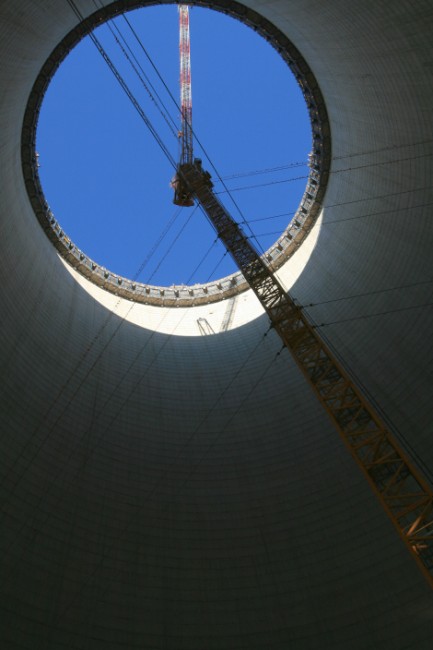
Left: Visitors get guided instruction of the
basic closed loop cooling system inside tower #2. Right: The new upper discharge basin. Simple methodology that carries a high price tag. The cooler, upward draft brings the
sprayed water’s temperature down; much like blowing air on your wet hands
will make them cold. Simple, right. Just keep the system from
icing up and it’s pretty much a trouble-free operation. The rub comes in
balancing the flow between what the sprayers can handle to the ever-changing
demands of the plant and the season’s temperature fluctuations. 70 million gallons are pumped through
the 10-foot-diameter underground pipes each day. The trick in the design is
to balance the cooling with the amount of water put into the system. If your
radiator in your car isn’t large enough, it will eventually overheat in warm
weather. Also, since antifreeze can’t be discharged into Mount Hope Bay, you
can’t allow the cooled water’s temperature to fall below freezing; otherwise
the system will ice up and shut down, much like your air conditioner’s
coils when the AC is turned on in the cold weather. Unlike your car, boat or home, you
just can’t shut off 1600 megawatts of electricity to a couple of million
homes, businesses and intuitions! So the upshot is the bigger the
“radiator” the more failsafe the system. “We expect the towers will perform in
a perfunctory manner,” Holt said. “This is proven technology, expensive but
proven.” Local and regional plant officials
were on hand to explain the above process to the hundreds of local area
residents who made reservations for the tour, and to dispel quirky rumors
that the plant may be going going nuclear. Brayton Point must be on-line on or before the
spring of 2012 to meet the EPA’s decree.
“We’ll meet that goal,” said Holt.
“This tour is to inform our neighbors of the progress we’re making, and to
educate them on the benefits that this 1.3 billion dollar project will have
on the environment.” But the towers are not without their critics. It had been reported that the
Somerset Board of Selectmen Chairman William Meehan said “People are saying
there’s going to be parts of the town where you won’t be able to see the
daylight until after 2 p.m.” One member of the tour groused that
the sound of the 24-hour pumps pushing 70 million gallons of water every day
through the closed loop system would add to the annoying hum of the existing
plant’s operational white noise.
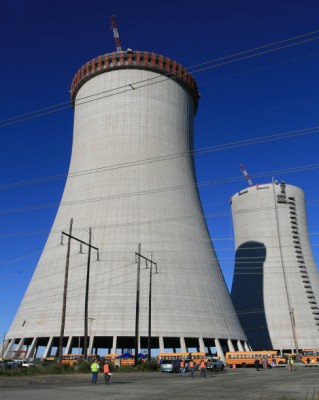
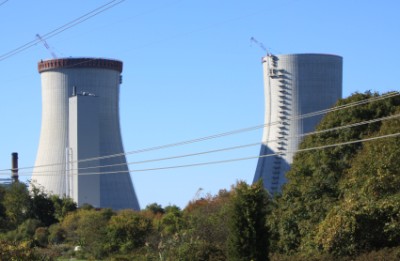
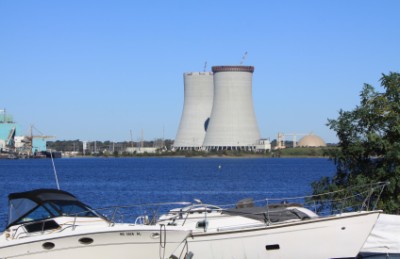
Left: View from Interstate 195. Right: View from the east bank of the
Taunton River. “Some
neighborhoods on the west side will be in shade for most of the day,” he
said. “I just don’t know how I feel about this.” Somerset Board of Selectmen Chairman
William Meehan said the town and Dominion are stuck in the same situation:
being forced to deal with something completely out of their hands. To be sure these
are all great concerns to nearby property owners. However, Brayton Point Station is under decree order to make these
changes. And they have been in business since 1962, long before these
environmental issues were raised and known to be troublesome. Not many of us
want higher energy prices, and the closure of Brayton
Point would have a dramatic impact on the cost of electricity. We live in a time
where pristine environments’ skylines are being changed, some with large wind
turbine farms and off shore drill rigs, and some with cooling towers. It’s
the cost of freeing us from exporting foreign oil. Could this be a
harbinger of a massive wind turbine taking center stage in Central Village? “We’re making
every effort to be a good neighbor and a dependable supplier of electricity
to our customers, “Holt said .
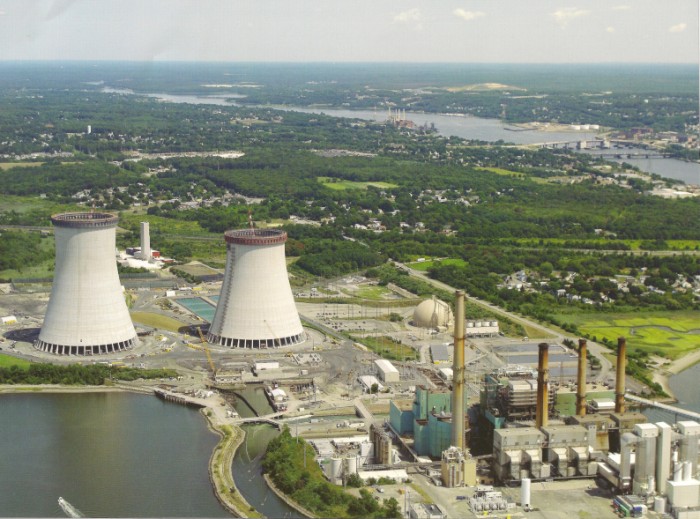
Photo courtesy of
Dominion Energy. - - - - - End - - - - - © 2010 Community Events
of Westport All rights reserved. EverythingWestport.com |