Westport in Brief!
EverythingWestport.com
Thursday, September 17, 2010
Quick Article Index . . .
Turbines
take a turn for the better.
|
Turbines take a turn for the
better. EverythingWestport.com Thursday, September 17, 2010 Photos/EverythingWestport.com
‘It’s not easy being green,’ Kermit
the Frog would sing. George Smith and Doris Mills now sing out of the same
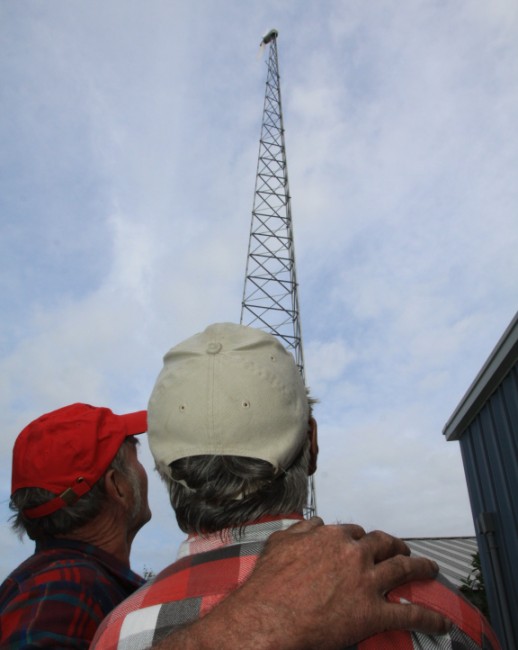
songbook. Left: George Smith of
Noquochoke Orchards gives Scott Fryer a hug as the blades start to spin on
the 140’ wind turbine. Click here to read about Noquochoke Orchards’ odyssey as they struggled to connect their new, state-of-the-art induction motor turbines to NSTAR’s power grid. The delay was in
the relay! Scott Fryer, Northeast Air installer, just shakes his head when recalling the
battle with NSTAR over a $200 relay. “These new turbines are used across the country, all with a very
affordable relay that protects the power grid against the turbine,” he said.
When the AC frequency or voltage gets outside the specifications of the electric
utility, the relay breaks the connection between the turbine and the grid.” “At the last minute NSTAR said our relay wasn’t sufficient, and required
an expensive ‘utility grade’ relay, power supply and motor contacts.” The additional cost? About $5000 more per turbine for the installation
(Noquochoke orchards have three). That money was to come right out of the
pockets of Smith and Mills. “Northeast Windpower provided some perfectly capable trip relays that have been in use with other comparable turbines across the country,” Fryer said. http://www.northeastwindpower.com/ But NSTAR said that Northeast Windpower’s relay was neither UL certified nor utility grade. They wanted the farm to install NSTAR’s more expensive equipment that would add up to $5000 per turbine to make the connection.
However, the power company said they were concerned about the safety of their network. But any power the farm’s turbines produce would be equivalent to adding a glass of water to the South Watuppa Pond, hardly the kind of energy that could inflict harm to NSTAR’s powerful grid. Left: The
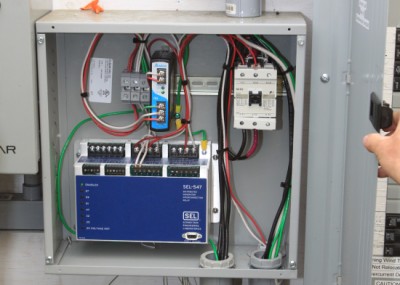
newly-installed distributed generator
interconnection relay manufactured by Schweitzer Engineering Laboratories
monitors over/under voltage and frequency variation set points as determined
by the state’s net metering rules as of December, 2009. Finally, with a little help from friends in high places, and a slight compromise on NSTAR’s part (they didn’t require the ‘utility grade’ power supply or motor contacts) the recalcitrant utility company issued a service order for the connection of the three wind turbines to the grid. “The Massachusetts’ utility tariff is perhaps the most stringent in the nation,” Fryer said. “Certainly New England has the toughest regulations.” The Massachusetts Department of Public Utilities (DPU) adopted amended net-metering rules in July of 2009 (see final order). These DPU rules were ordered in accordance with the legislative changes instituted in 2008. Furthermore in August of 2009, the DPU issued its model net metering tariff and new utility net metering tariffs for the state's investor-owned utilities (Unitil, National Grid, NSTAR, and Western Massachusetts Electric Company) that became effective December of 2009. “In other parts of the country the $200 protective relay has been satisfactory,” Fryer said. “This situation with NSTAR took us by surprise, and we didn’t want to establish a precedence that might affect all future installations.”
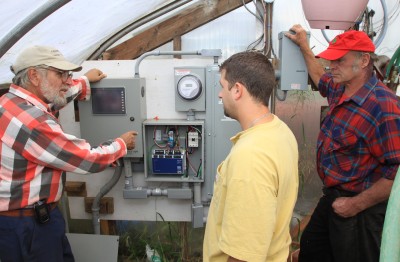
Left: The new relay didn’t power up when the
circuit breaker was first turned on, prompting Fryer (left) and Campbell (center) to troubleshoot the problem
while George Smith anxiously looked on. Sheepishly, they had forgotten that
the relay forces a five minute delay before resetting itself after the circuit
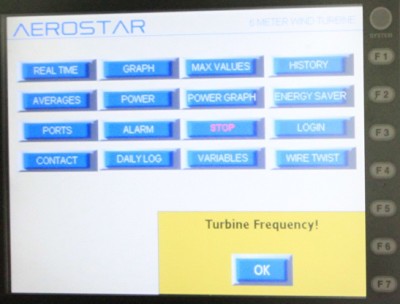
is tripped or turned off. Right: The comprehensive electronics
display panel that monitors the wind turbine’s performance and stability of
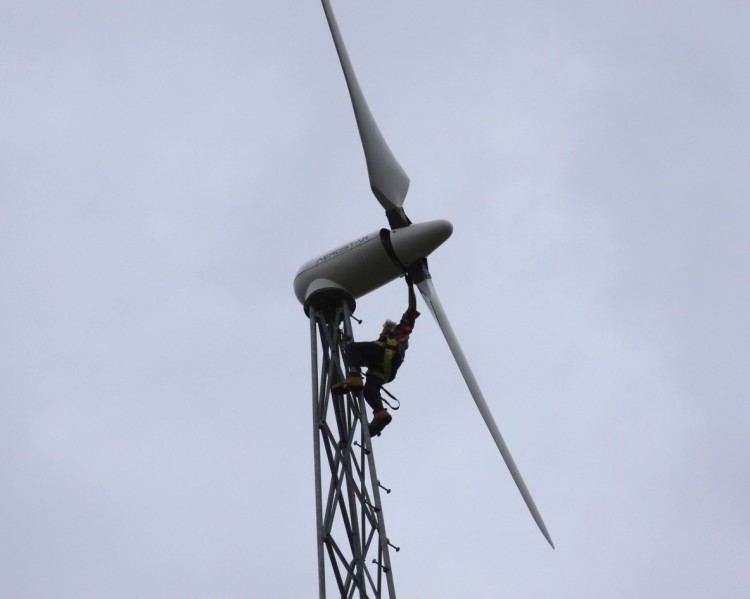
operation. In the end NSTAR had their way, and Northeast Windpower installed the required equipment with the help of Jason Campbell of CEG Consulting out of Hopedale, Massachusetts. NSTAR certified the installation, and on the afternoon of September 16th Fryer and Campbell flipped the switch and made the connection to NSTAR’s grid. NSTAR did make a small concession that saved the farm about $1500 per turbine. Finally, to add insult to injury, the first turbine didn’t start to spin when its brake was released. “The turbine was inactive for such a long period of time, the moving parts had stiffened up,” Fryer said. “I had to make the 140’ climb up the tower and spin the blades and hub by hand, much like starting a gas-powered model airplane (pictured below).” Pioneers always have the most arrows shot in their backsides, even if the arrows are green.
- - - - - End - - - - - © 2010 Community Events
of Westport All rights reserved. EverythingWestport.com |
 Not true says
Fryer. “Our trip relay is UL certified and only costs $200 per turbine to
install.”
Not true says
Fryer. “Our trip relay is UL certified and only costs $200 per turbine to
install.”