Westport
in Brief!
EverythingWestport.com
Sunday, January 02, 2011
photos/EverythingWestport.com
Quick
Article Index . . .
Beaten to a pulp,
and the fiber is better for it.
|
Beaten to a pulp, and the fiber is better for it. EverythingWestport.com Tuesday,
March 15, 2011 photos/EverythingWestport.com View
photo album now - 42 photos | Dial-up speed | Broadband/DSL speed
|
But
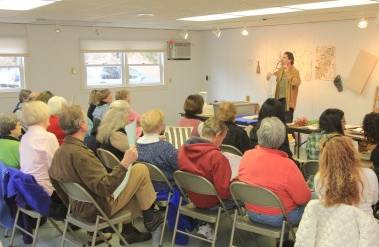
there the similarity ends. The Westport Art Group
recently sponsored a paper-making demonstration with Wayne Fuerst of Sticks,
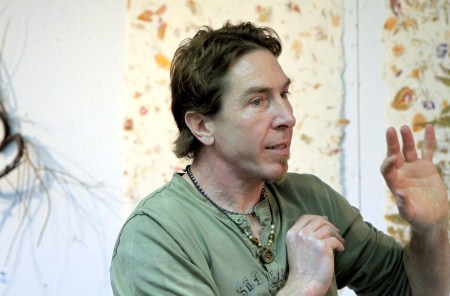
Stones & Stars to a full house at the WAG's center on 782 Main Road. Wayne Fuerst trained in
handmade paper techniques at Rugg Road Paper. "My
papers use a mixture of custom-blended fibers for strength and texture,"
said the likable artisan who is also a master potter and painter. "With
paper it's all about the fibers and how they interlock with each other." Paper
mills use mostly forested wood pulp to make their products. Fuerst uses just
about everything else, including exotic woods and blue jeans (used for the cotton
fiber).
"My
papers are made from cotton and abaca (banana plant) fibers. The fibers are
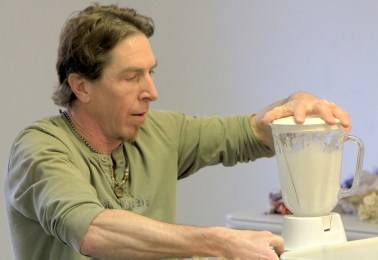
processed in a beater to a homogenous consistency we call pulp," Fuerst said. "Abaca is added to the cotton fiber to
make the paper stronger." Fuerst creates and sells
his beautiful pieces of hand-made paper at his artisan gallery, Sticks, Stones and Stars at 782 Main
Road, Westport. What
separates Fuerst from most artists is his ability
to convey to the average layman and artisan alike the nature of his craft and
his own abilities to produce it. He's a natural-born presenter; not too
hurried and perfectly comfortable talking with people. Fuerst
is an instructor extraordinaire. Wayne
Fuerst is a Ceramics/Pottery teacher at Harvard
University, and at MudFlat Studio in Somerville. He orchestrated
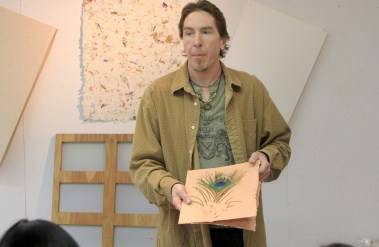
a show and tell from a portfolio of hand-crafted papers he has created over
the years working for himself and others. He sprinkled anecdotes throughout
the two-hour talk by explaining the different techniques used in crafting European
and Asian papers.
With
several of his hand-made papers framing him as a backdrop, Fuerst took his audience through the techniques of paper
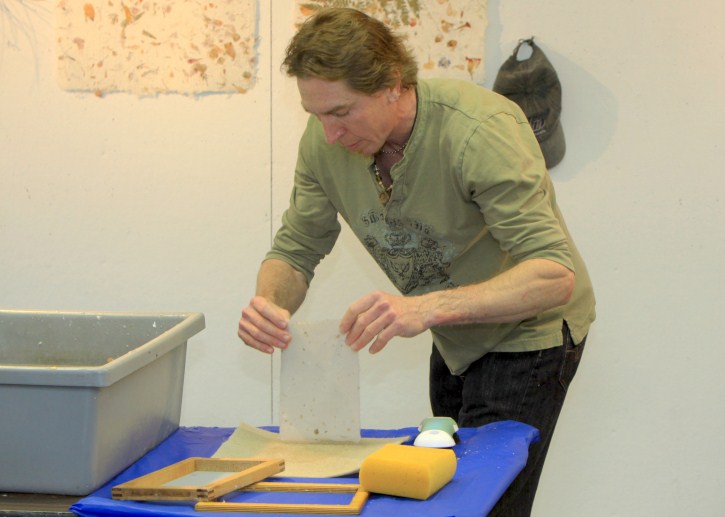
making; from beating the raw stock fibers into a thick soupy mass, to peeling
the still-wet paper from its screened frame and placing it on a wool drying
sheet and also, to the amusement of his listeners, onto the WAG's glass
windows. Using
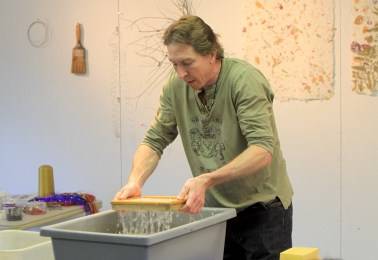
only equipment, mostly simple blenders, beaters, and plastic containers and
tubs from his home studio, Fuerst walked attendees
through the process of making a sheet of paper, explaining every step and
potential problem areas to avoid. "If
the sheet is bad, simply throw it back into the mix," he said. Flower
petals, cattail fiber, glitter, fabric, threads and pigment can be added to
the pulp. The mixture is then suspended in water and a screen is pulled
through the mixture to lift a sheet of paper. The paper is then pressed and
transferred to dry. The fibers have now been transformed into a lustrous
sheet of fine, handmade paper.
But
what separates student from artist is the creative gift of manipulating the
process. "My
real love of paper making is painting with the fiber," Fuerst told the listeners. His
papers range from the greeting card size to large 32 x 38 pieces of artwork
made with different colors of paper pulp. They are usually made from cotton
and abaca (banana plant) fibers. The fibers are processed in a beater to a
homogenous consistency called pulp. Feurst's papers are used
for greeting cards, personalized invitations, customized wedding invitations,
stationery and gifts. Fuerst is a master potter,
paper maker, and painter living in Westport. He studied at the "The
many disciplines of the artisan community here today are further enlightened
by Wayne Fuerst's presentation. Not many of us have
experimented in making paper. This was a true education," said one
attendee.
The
Westport Art Group is a non-profit organization that supports education in
the arts with classes, art exhibits and scholarships to high school seniors.
The mission of the Westport Art Group is to stimulate and promote the
appreciation and encouragement of the arts and crafts. Call or click (508)
636-2114 or visit www.westportartgroup.com for more information. © 2011 Community Events of Westport. Some rights
reserved. EverythingWestport.com |