Westport in Brief!
EverythingWestport.com
Tuesday, August 30, 2011
Quick Article Index . . .
|
EverythingWestport.com Tuesday, August 30, 2011 Photos by EverythingWestport.com If you're wondering where area seagulls have got to since Irene's
departure, look no further than Cherry & Webb Beach and Horseneck Point
where hundreds of the pesky long-winged, web-footed, aquatic scavengers have
been gorging on the thousands of sea clams scrubbed from the ocean floor and
pitched up onto the beach's high-water mark by the roiling waves of tropical
storm Irene. "We lost a lot of sand on Horseneck Point and 'boaters'
beach'," Harbormaster Richie Earle said. "The dunes took a real
beating." “There is no East Beach Road right now,”
Selectman Richard Spirlet said at a recent
emergency meeting, a sentiment echoed by Fire Chief Brian Legendre who said
the "town beach is gone." Is beach erosion threatening our beloved Cherry & Webb as well? The Horseneck Point beach area was replenished with thousands of cubic
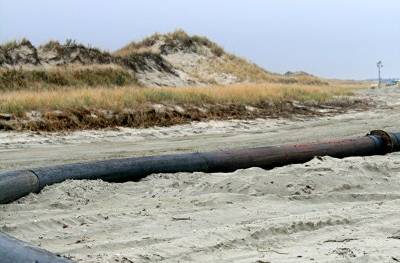
yards of sand dredged from the Westport Harbor Channel in the winter of
2007/2008. That sand is long gone, swept away by past winter storms and high moon
tides..
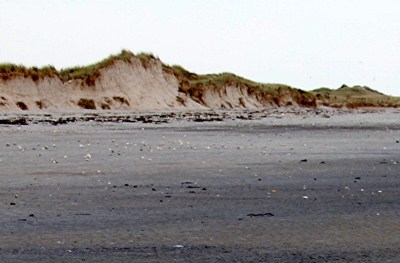
Above: Photo of Horseneck Point (left) taken on August 30, 2011
clearly shows a loss of two to four feet of beach, scoured and flattened by
Irene. The protective barrier dunes
have been severely slashed back by the storm surge, losing 30 yards of
valuable dune grass as compared to
the photo on the right taken on November 21, 2007 during the channel dredging
project. "During winter storms (and hurricanes), energetic waves scour
sand from the visible part of the beach, transporting it to an offshore
sandbar. The bar then dissipates the wave energy and protects the beach from
further damage," explained Nicole Elko, Ph.D., coastal coordinator for
Pinellas County, Florida in an article by the American Shore & Beach
Preservation Association. "This results in a flatter, narrower beach than in the
summertime." "Over time, as the calm spring and summer weather returns, the
waves get smaller and slowly return the sand from the sandbar back onto the
visible portion of the beach. This process is called accretion." "Some beaches do not have enough sand available to respond
naturally to storms," she explained. This sand starvation can be due to
natural causes, such as sea level rise, or blocking of natural sand movement
by impediments such as seawalls, jetties, inlets, harbors or dams. "When there is not enough sand on a beach, it is not able to
recover fully after a storm," Elko concluded. Whether accretion is happening at Horseneck Point remains to be seen,
but there is little evidence the sand lost there will ever return.
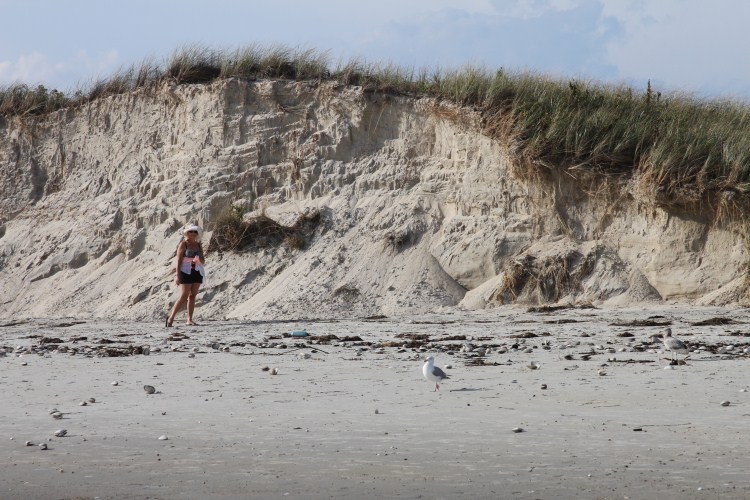
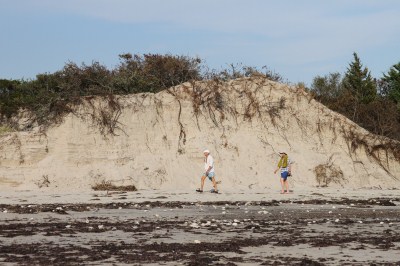
An unidentified woman walks past 18 feet of exposed dune at Horseneck
Point.
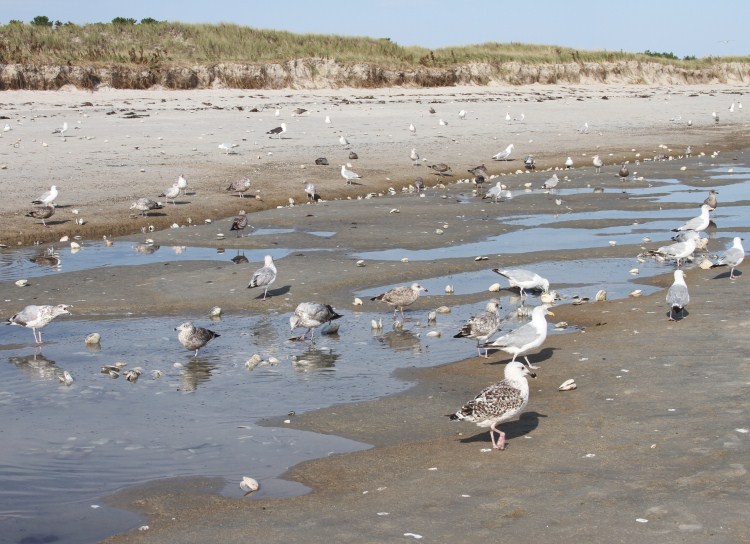
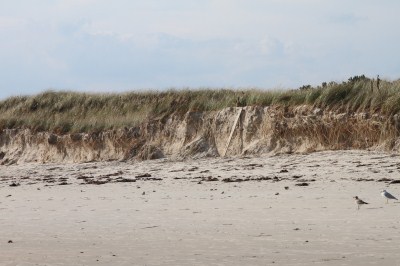
Seagulls feasting on the thousands of sea clams left high and dry by
tropical storm Irene.
Left: two men walk by the this ravaged dune at 'boaters' beach'. Right:
the dunes at Horseneck Point and the west side of Cherry & Webb Beach
have been severely cut back by Irene's storm surge.
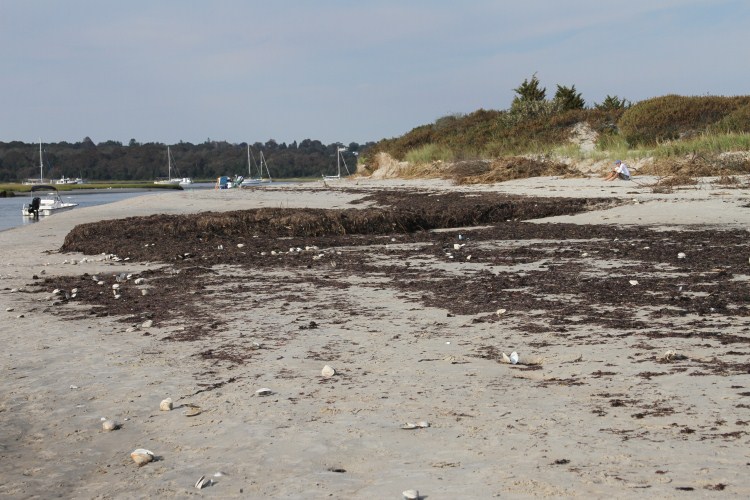
'Boaters' beach', as seen during the last new moon, low tide on August
30, 2011, may no longer be assessable at high tide, especially during a full
moon.
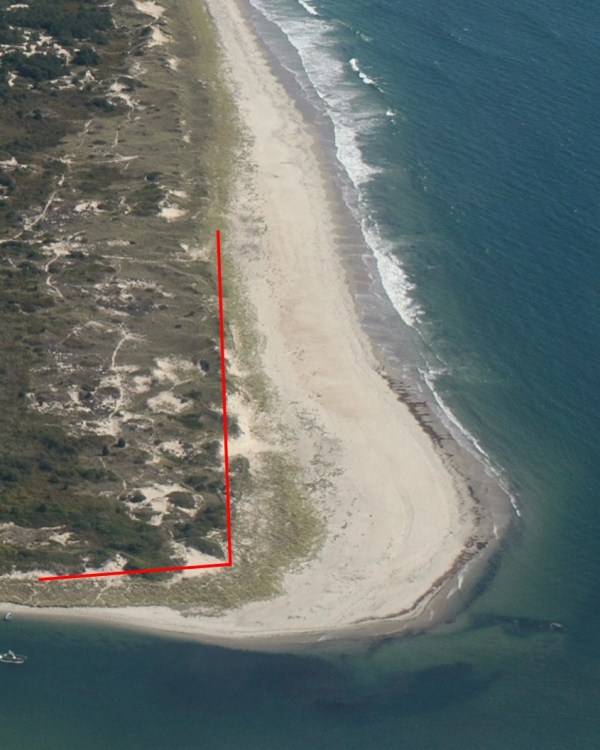
Above: Red line highlights dune and vegetation loss at Horseneck Point and
'boaters' beach'. Aerial photo taken September 25, 2005. - - - - - End - - - - - ©
2011 Community Events of Westport
All rights reserved. EverythingWestport.com |